 NightShift
An after-hours answering service for home-service businesses. A voice agent answered the calls, Claude drafted replies to texts and scored every lead, and the owner's briefing was ready by morning. I built it from March to May 2026, then stopped.
- 33
- Convex tables
- 35
- verification scripts
- Phone + SMS
- channels
- Mar–May 2026
- build window
Where v1 stood when I stopped.
Phone and SMS only. Every message was sorted and scored, confident replies went out on their own behind safety gates, and one internal console handled the exceptions.
Answer
After hours, a Retell voice agent picked up forwarded calls and Twilio carried the texts. Returning callers were greeted by name.
Call or textSort
Each message was classed as a lead, a support issue, a general question, or a message for the owner. Spam got no reply.
Claude HaikuReply
Sonnet drafted a qualifying reply from the business's own details. Confident replies went out on their own; anything unclear was flagged for review.
Claude SonnetBrief
Hot leads triggered a text alert, held until quiet hours ended. Everything else went into a scored briefing by email and text.
By morningFive parts: the backend, the voice layer, the safety gates, the operator console, and the public site.
One Convex backend for every business.
Every table hangs off a business ID, so adding a business was configuration, not a migration. Records change by status instead of being deleted, which left an audit trail for every message, score, draft, and send.
33 tables · keyed by businessMoved the voice agent to Retell.
The first voice layer ran on Vapi. In April 2026 I rebuilt it on Retell with a conversation-flow agent, a SIP trunk to Twilio, and Cal.com tools the agent could call to book a slot mid-call.
Retell · Twilio SIP · Cal.comGates before anything went out.
Replies only went out after hours, and hot-lead alerts waited out quiet hours. A business couldn't go live until its activation checks passed. Failed AI calls retried, then surfaced in monitoring instead of failing silently.
After hours only · quiet hours · activationAn internal console, not a customer dashboard.
The owner was never meant to log in to anything. The console was for me: four views, a client drawer, and a command palette for watching the system and handling exceptions.
Pulse · Clients · Review · SettingsSite, demo call, and checkout.
The public site let a visitor talk to the voice agent from the browser, book a walkthrough in an embedded Cal.com window, and check out through Stripe after accepting the terms.
React 19 · Vite · Stripe- Built the core
Started as after-hours inbox triage: intake, Convex storage, classification, lead scoring, grounded draft replies, and an operator workspace.
- Moved to voice
Rebuilt the voice layer on Retell, narrowed the channels to phone and SMS, and added AI classification, quiet hours, and returning-caller recognition.
- Finished the front door, then stopped
Shipped the in-browser demo call, Cal.com booking, Stripe checkout, and the activation gate. Feature work ended there.
The repo is private. Nothing here names a business, a caller, or a phone line.
Private React and Convex app with the voice, SMS, triage, drafting, briefing, and operator code, 35 verification scripts, and 77 test files.
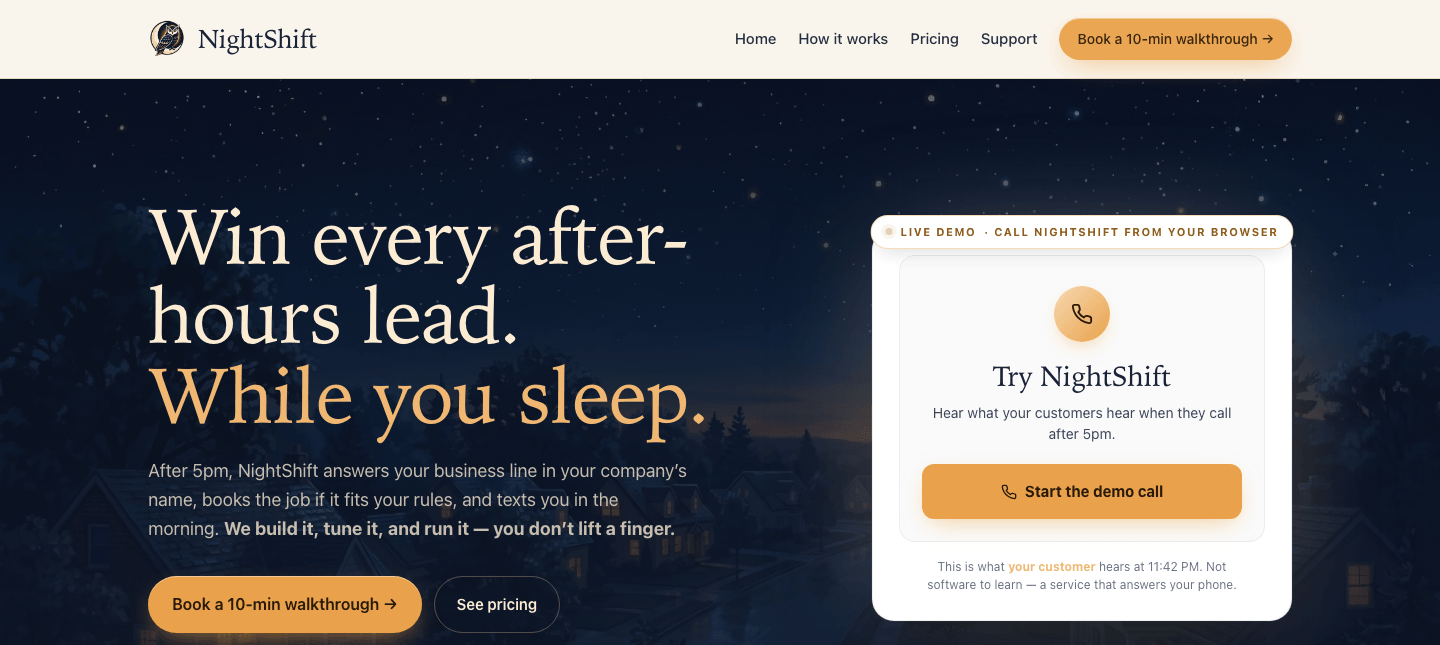
private repoThe public site as it stood in May 2026: the hero, the demo-call card, and walkthrough booking.
screenshot · May 2026A dated spec for channels, message categories, auto-send rules, and what the product would not do.
internal doc · May 2026